
Mowgli: Legend of the Jungle is a 2018 adventure drama film directed by Andy Serkis. It presents a darker, more faithful adaptation of Rudyard Kipling’s stories, focusing on the human child Mowgli’s journey of self-discovery after being raised by wolves in the Indian jungle.
Some stories never get old, and Rudyard Kipling’s The Jungle Book is a prime example. This timeless narrative about a boy raised by animals has captivated generations and inspired countless adaptations. However, Netflix’s Mowgli: Legend of the Jungle offers a starkly different experience. It strips away the whimsical veneer, diving headfirst into the raw, often brutal, realities of the wild to deliver a darker, more grounded take on the classic.
Directed by motion-capture maestro Andy Serkis, this film was an ambitious project promising a grittier, more faithful interpretation of Kipling’s original work. From its stunning visuals to its emphasis on the harsh “Law of the Jungle,” Mowgli: Legend of the Jungle immediately sets itself apart. The story explores the challenging identity of a ‘man-cub’ caught between two worlds as he struggles to find his place in a perilous ecosystem. But does this bold, somber departure from the familiar make for a compelling watch, or does it get lost in the dense foliage?
In this in-depth review, we will analyze this unique adaptation from top to bottom. We’ll explore what is Mowgli: Legend of the Jungle about, delve into its impressive cast, and examine the thematic choices that make it so distinct. Join us as we journey into a different kind of jungle to determine if this legend is worth adding to your watchlist.
What Is Mowgli: Legend of the Jungle About?
A More Faithful, Grittier Adaptation
Mowgli: Legend of the Jungle offers a distinctly darker vision of the beloved tale by embracing the raw essence of Rudyard Kipling’s original stories. Director Andy Serkis creates a more mature and grounded cinematic experience that doesn’t shy away from harsh realities. The film explores the brutal ‘Law of the Jungle’ with an unflinching honesty, resulting in a grittier, more realistic tone that stands out from lighter predecessors.
This focus on realism is evident in the detailed motion-capture performances, which give the animal characters striking visual depth. The film also delves into complex themes of survival, identity, and the natural order, presenting a world where beauty and danger coexist. This approach provides a fresh, more intense narrative for fans of The Jungle Book.
The Core Plot and Conflicts
The story revolves around Mowgli, an orphaned human child adopted by a wolf pack in the Indian jungle. Raised among the animals, he learns to follow the strict ‘Law of the Jungle’ under the guidance of his primary mentors:
- Bagheera (Christian Bale): A wise and protective black panther.
- Baloo (Andy Serkis): A tough but kind bear, responsible for teaching the wolf cubs.
However, Mowgli faces a constant threat from the fearsome tiger Shere Khan (Benedict Cumberbatch), who holds a deep hatred for humans and relentlessly hunts the boy. This external conflict forms the narrative’s backbone, while Mowgli’s internal struggle with his identity—neither fully wolf nor fully human—provides the film’s key emotional thread.
As Mowgli grows, he becomes an outcast, viewed with suspicion by the animals for his human traits while fearing the humanity he doesn’t understand. His journey eventually leads him to a human village, where he confronts new challenges and temptations. In the end, Mowgli must not only confront Shere Khan but also decide where his true allegiance lies, a climactic struggle that will define his place in the world.
Who Is in the Cast of Mowgli: Legend of the Jungle?
Curious about who brings the vibrant world of Mowgli: Legend of the Jungle to life? This dark adaptation boasts a remarkable ensemble, featuring a compelling young actor and an incredible roster of voice talent who make the jungle’s inhabitants unforgettable.
The Human Characters
The central figure in this gritty tale is, of course, Mowgli, portrayed by Rohan Chand. Chand delivers a powerful performance, capturing the internal struggle of a human boy navigating the perilous “Law of the Jungle.”
- Rohan Chand as Mowgli: Chand’s portrayal is raw and emotionally charged, expertly conveying Mowgli’s isolation and longing for belonging. His journey forms the heart of the film.
The Star-Studded Voice Cast
While Rohan Chand grounds the human element, a truly stellar cast lends their voices to the iconic animal characters, bringing depth and gravitas to their roles and elevating the film’s dramatic intensity.
- Christian Bale as Bagheera: As the voice of the wise and protective black panther, Bale’s commanding tone perfectly suits Mowgli’s stern mentor and constant guardian.
- Cate Blanchett as Kaa: Blanchett gives a mesmerizing and hypnotic performance as the ancient python, who serves as both a mysterious narrator and an ominous presence.
- Benedict Cumberbatch as Shere Khan: Cumberbatch embodies the fearsome tiger, using his deep, menacing tones to make Shere Khan a truly terrifying villain and the jungle’s ultimate predator.
- Andy Serkis as Baloo: Director Andy Serkis also takes on the role of the gruff but kind-hearted bear. Renowned for his motion-capture work, Serkis’s voice acting brings nuance to Baloo, Mowgli’s second mentor who helps train the young boy.
- Naomie Harris as Nisha: Harris voices the fiercely maternal wolf who adopts Mowgli. As his surrogate mother, Nisha shows immense loyalty.
- Peter Mullan as Akela: Mullan provides the voice for the stoic leader of the wolf pack, who maintains order by upholding the jungle’s strict laws.
- Freida Pinto as Messua: Pinto portrays the kind human woman who offers Mowgli a place in the village, giving him a glimpse of another world.
- Matthew Rhys as John Lockwood: Rhys plays a British hunter who represents the encroaching human world and poses a threat to the jungle.
How Does This Film Differ from Other ‘Jungle Book’ Adaptations?
Tone and Visual Style
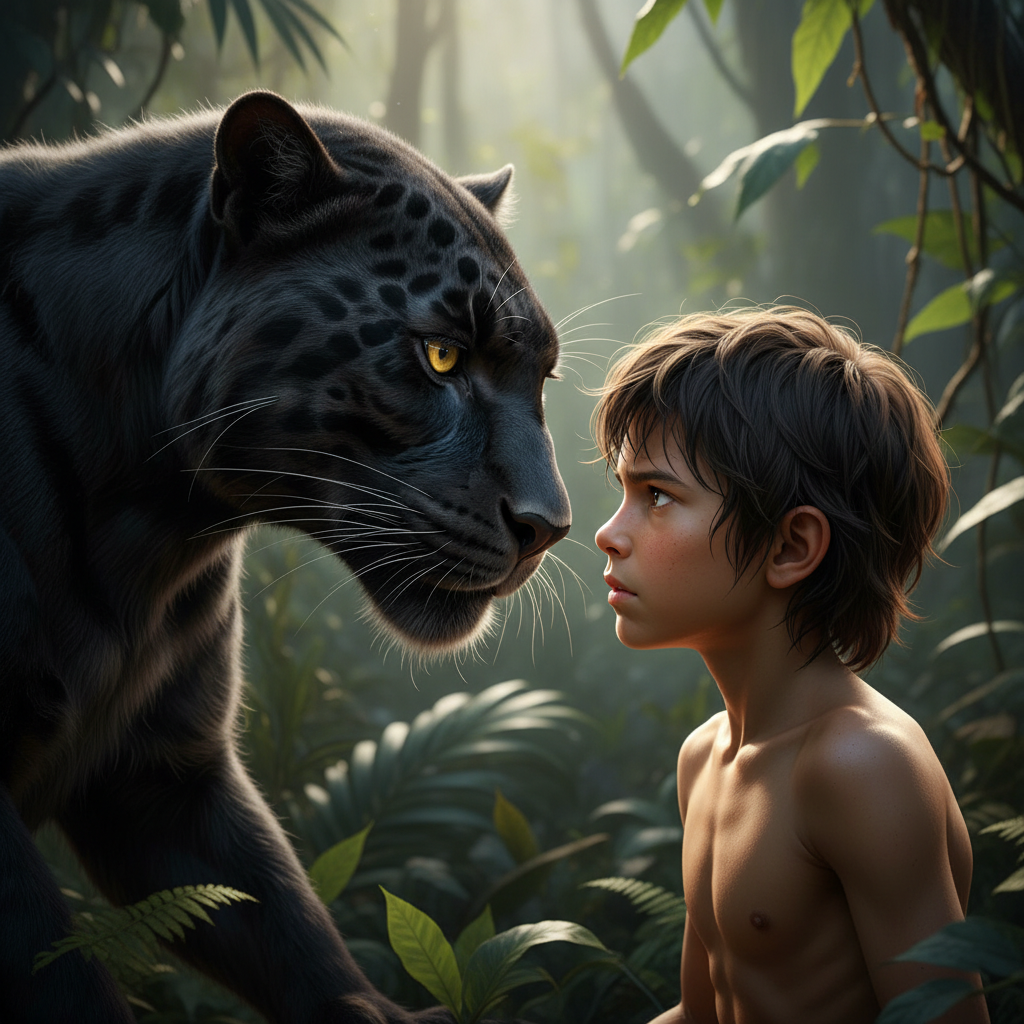
The most striking difference in Mowgli: Legend of the Jungle, compared to previous adaptations, is its uncompromising tone. This film takes a distinctly darker, grittier approach. It is not a whimsical musical; instead, it leans into the raw, often brutal reality of the wild.
The visual style further underscores this intensity. Director Andy Serkis, renowned for his motion-capture work, used sophisticated technology to bring the jungle animals to life. However, this commitment to realism also sparked debate among viewers.
- Realistic CGI: The animals are highly detailed and lifelike, unlike the stylized, anthropomorphic designs common in other versions. They often look formidable and can even be unsettling.
- Motion Capture Performance: A star-studded cast, including Serkis himself as Baloo and Benedict Cumberbatch as Shere Khan, performed the key animal roles using motion capture. This technique imbued the creatures with nuanced, human-like expressions, but critics noted that the results sometimes veered into the “uncanny valley” [1].
- Atmosphere: The jungle itself feels dangerous and untamed. Lush visuals are often punctuated by scenes of harsh survival and predation, creating a much more somber and serious atmosphere than its predecessors.
- Color Palette: While vibrant, the colors often have a deeper, more muted quality that reflects the film’s serious narrative. This contrasts sharply with the brighter, more saturated palettes of family-friendly adaptations.
The film was initially planned for a theatrical release by Warner Bros. Pictures but was later acquired by Netflix, where it debuted globally [2]. This distribution change highlighted its mature approach, signaling that it might not fit the typical family blockbuster mold.
Key Thematic Differences
Beyond its visual style, Mowgli: Legend of the Jungle explores its themes with greater depth and a bleaker outlook. The film delves into the story’s core conflicts with a confronting realism, resulting in a more complex narrative.
- The Struggle for Identity: Mowgli’s “man-cub” status is a constant, agonizing source of conflict. He truly struggles to belong, feeling like an outcast among both wolves and humans. This internal struggle is a more central and painful element than in other adaptations, which often celebrate or simply accept his human nature.
- The Unforgiving Law of the Jungle: The jungle’s laws are not mere guidelines; they are brutal tenets of survival. This film emphasizes the “red in tooth and claw” aspect of nature. Characters face genuine life-or-death stakes, and the consequences for breaking the law are severe, leaving little room for romanticism.
- Humanity’s Impact: The film takes a starker look at human encroachment on the wilderness. The hunter John Lockwood (Matthew Rhys) and the nearby village pose a direct threat to the jungle’s ecosystem. As a result, themes of environmental conflict and human destructiveness are far more pronounced.
- Moral Ambiguity: Characters, even traditionally benevolent ones like Baloo and Bagheera, take tougher, sometimes morally ambiguous actions. Their decisions are driven by the harsh realities of survival, making for more nuanced characterizations that move beyond simple good-versus-evil archetypes.
- Darker Undertones: Themes of abandonment, prejudice, and the harsh realities of power are woven throughout the narrative. The stakes feel higher, and the emotional toll on Mowgli is palpable, ensuring the story resonates with a more mature audience.
Ultimately, this version of Mowgli: Legend of the Jungle is less a retelling and more a reinterpretation. It asks harder questions and presents a more challenging viewing experience—one that may be more rewarding for audiences seeking a less sanitized take on Rudyard Kipling’s classic.
What Are the Main Themes of the Movie?
The Struggle for Identity
Mowgli’s journey in Mowgli: Legend of the Jungle is a fundamental exploration of identity. Living between two distinct worlds, he is raised by wolves and is a true member of the pack. Yet, his inherent human nature constantly challenges this sense of belonging.
His inner conflict is palpable throughout the film. Possessing human curiosity and ingenuity, Mowgli feels inherently different from the animals that surround him. Still, he strives desperately to fit into the jungle’s strict hierarchy and traditions. This constant duality fuels much of the film’s drama and his personal struggles.
This profound struggle is portrayed through several key aspects:
- Physical Differences: Mowgli lacks the innate physical prowess of the animals. He cannot climb like a monkey or run like a wolf, a physical distinction that immediately sets him apart.
- Learned Behavior: While he diligently adopts animal mannerisms and survival skills, his human intellect often leads to unconventional solutions, such as instinctively using tools—a behavior foreign to most animals.
- Emotional Connection: He feels deep loyalty and love for his wolf family. However, encounters with humans stir a different and often confusing longing within him, causing him to ponder his true origins and place.
- Acceptance and Rejection: While some animals, like Baloo and Bagheera, accept him almost without question, others, particularly the menacing Shere Khan, view him as a dangerous outsider and a threat to their established order.
Ultimately, Mowgli must reconcile these two sides of his being. He seeks to forge his own path rather than merely choosing one world over the other. This means bravely embracing both his wild, nurturing upbringing and his human heritage. It is a powerful, universal narrative about belonging, self-discovery, and finding one’s true place in the world.
The Law of the Jungle
The “Law of the Jungle” is far more than a memorable phrase in Mowgli: Legend of the Jungle; it is the backbone of jungle society. This ancient code dictates life, death, and the social order, ensuring a delicate balance among predators and prey.
Rudyard Kipling first penned these intricate laws for his original stories [3], and the film brings them to visceral, compelling life. These laws govern how animals interact, defining their individual and collective responsibilities. Ignoring these sacred rules inevitably brings chaos and danger to all.
Key tenets of the Law of the Jungle include:
- Respect for Life: Hunting is strictly for sustenance, never for sport or cruelty. No animal kills out of malice, a principle that maintains ecological balance.
- Pack Unity: “The strength of the Pack is the Wolf, and the strength of the Wolf is the Pack.” This central maxim emphasizes community and collective well-being over individualism.
- Territory and Boundaries: Each species has its designated place. Crossing these established lines without cause can quickly lead to conflict.
- Fair Play: Even during a hunt, specific rules apply to ensure fairness. For instance, prey must always have a fighting chance to escape.
- Responsibility: The older, stronger, and wiser animals are expected to protect the younger and weaker members, as leadership carries significant duties.
Mowgli constantly navigates these complex and often harsh rules, and he struggles to understand their full implications. His human instincts frequently clash with ingrained jungle traditions. For example, his inventive use of fire, a powerful human tool, directly challenges established norms. However, he eventually learns to master this fundamental law, using it to protect his adopted home and the creatures within it. This theme powerfully highlights the importance of order, natural justice, and the dire consequences when that order is threatened.
Is Mowgli: Legend of the Jungle Worth Watching?
Our Final Verdict
Is Mowgli: Legend of the Jungle worth watching? Absolutely, but with some key considerations. This adaptation from director Andy Serkis offers a distinctive vision. It’s a grittier, more mature take on Rudyard Kipling’s classic stories that stands apart from other interpretations.
The film’s strengths are undeniable. The visual effects are breathtaking, with creature designs that feel grounded and realistic. Additionally, the impressive motion-capture performances bring the animal characters to vivid life. The voice cast—including Christian Bale as Bagheera and Benedict Cumberbatch as Shere Khan—delivers powerful portrayals that lend gravitas to their roles.
However, the film isn’t without its challenges. Its darker, more somber tone can feel relentless at times and may not appeal to all viewers. The pacing also slows down occasionally, which might cause some to disengage. Ultimately, if you are seeking a faithful, intense, and thought-provoking adaptation, this movie delivers, offering a stark contrast to lighter versions of the story.
Who Should Watch This Movie?
Is Mowgli: Legend of the Jungle the right movie for you? Here’s a breakdown of its ideal audience:
- Fans of Darker Adaptations: If you appreciate films that give classic tales a serious, often grim tone, this movie is for you. It explores the harsh realities of the jungle.
- Readers of Kipling’s Original Works: Those familiar with Rudyard Kipling’s original Jungle Book will find this version more aligned with his themes, as it avoids the whimsical nature of other adaptations.
- CGI and Motion-Capture Enthusiasts: Viewers interested in cutting-edge visual effects and remarkable motion-capture performances will be impressed.
- Adults and Mature Young Adults: This is not a children’s movie. Its violence and themes of identity, belonging, and survival are more suited for older audiences.
- Viewers Seeking a Different “Jungle Book”: If you’re tired of the more family-friendly versions, Mowgli: Legend of the Jungle provides a refreshing change.
Conversely, if you expect a lighthearted, musical adventure similar to Disney’s animated classic, you might be disappointed. This film delves deep into the struggles of its characters, prioritizing realism and emotional weight over simple entertainment.
Frequently Asked Questions
Where can I watch Mowgli: Legend of the Jungle?
Yes, you can! As a Netflix Original film, Mowgli: Legend of the Jungle is available to stream exclusively on Netflix worldwide [4].
To watch, simply open Netflix on any supported device, such as a smart TV, computer, tablet, or smartphone. Enjoy exploring the film’s darker vision of the jungle!
Is there a Mowgli: Legend of the Jungle 2?
Currently, there are no official plans for a sequel, Mowgli: Legend of the Jungle 2. Director Andy Serkis has not announced development for a follow-up, as the movie was intended to be a standalone adaptation of Rudyard Kipling’s classic stories.
The film tells a complete, self-contained narrative with a definitive ending. For this reason, while fans may hope for more, a sequel seems unlikely at this time.
Who is the cast of Mowgli: Legend of the Jungle?
Mowgli: Legend of the Jungle features an incredible ensemble, combining live-action performances with a star-studded voice cast for the animal characters. Here are the key players:
| Actor/Actress | Character | Role Type |
|---|---|---|
| Rohan Chand | Mowgli | Live-action |
| Matthew Rhys | John Lockwood | Live-action |
| Freida Pinto | Messua | Live-action |
| Andy Serkis | Baloo | Voice/Motion-capture |
| Christian Bale | Bagheera | Voice/Motion-capture |
| Cate Blanchett | Kaa | Voice/Motion-capture |
| Benedict Cumberbatch | Shere Khan | Voice/Motion-capture |
| Naomie Harris | Nisha | Voice/Motion-capture |
| Peter Mullan | Akela | Voice/Motion-capture |
| Jack Reynor | Brother Wolf | Voice/Motion-capture |
| Eddie Marsan | Vihaan | Voice/Motion-capture |
The film is notable for its use of advanced motion-capture technology, which allowed the actors to bring incredible nuance to their animal roles [5]. This approach helps create a truly distinctive and immersive experience.
Is Mowgli: Legend of the Jungle available on DVD?
Yes, it is. Despite being a Netflix Original, Mowgli: Legend of the Jungle received a physical media release on DVD and Blu-ray in select regions [6]. This is somewhat unusual for a Netflix-exclusive film and is great news for collectors!
Copies can often be found through major online retailers and local media stores. These physical versions typically include bonus features that provide a deeper dive into the film’s production and stunning visual effects, making them perfect for fans.
Sources
- https://www.hollywoodreporter.com/review/mowgli-legend-jungle-review-1165275
- https://deadline.com/2018/07/andy-serkis-mowgli-netflix-warner-bros-the-jungle-book-1202434522/
- https://www.kiplingsociety.co.uk/kip-articles/the-law-of-the-jungle-2/
- https://about.netflix.com/en/news/netflix-will-release-andy-serkis-mowgli-legend-of-the-jungle-globally-in-2019-2019-01-22
- https://www.hollywoodreporter.com/news/mowgli-legend-of-the-jungle-stars-on-the-film-s-darker-tone-and-how-it-differs-from-other-adaptations-1165249
- https://www.blu-ray.com/movies/Mowgli-Legend-of-the-Jungle-Blu-ray/222301/
